
The Desiring Self
On appetite, shame, and the fear of wanting too much

“Last year I abstained, this year I devour without guilt, which is also an art.” – Margaret Atwood.
I have been learning how to want. Or, more accurately: learning how to tell my own wanting apart from the desires I believed were better than mine.
When I first began this mission, many years ago now, I thought it would take not much more than stubbornness - the blunt force of rage, a desire for reclamation, an unearthed awareness of just how much there was to reclaim. I would achieve it through the sheer force of my mind’s will, I thought. What I didn’t know was that understanding was not the same as believing, and that it would require something harder won: a softening, accumulated over hundreds of small choices to listen to myself, and to trust that there was nothing wrong in what I heard.
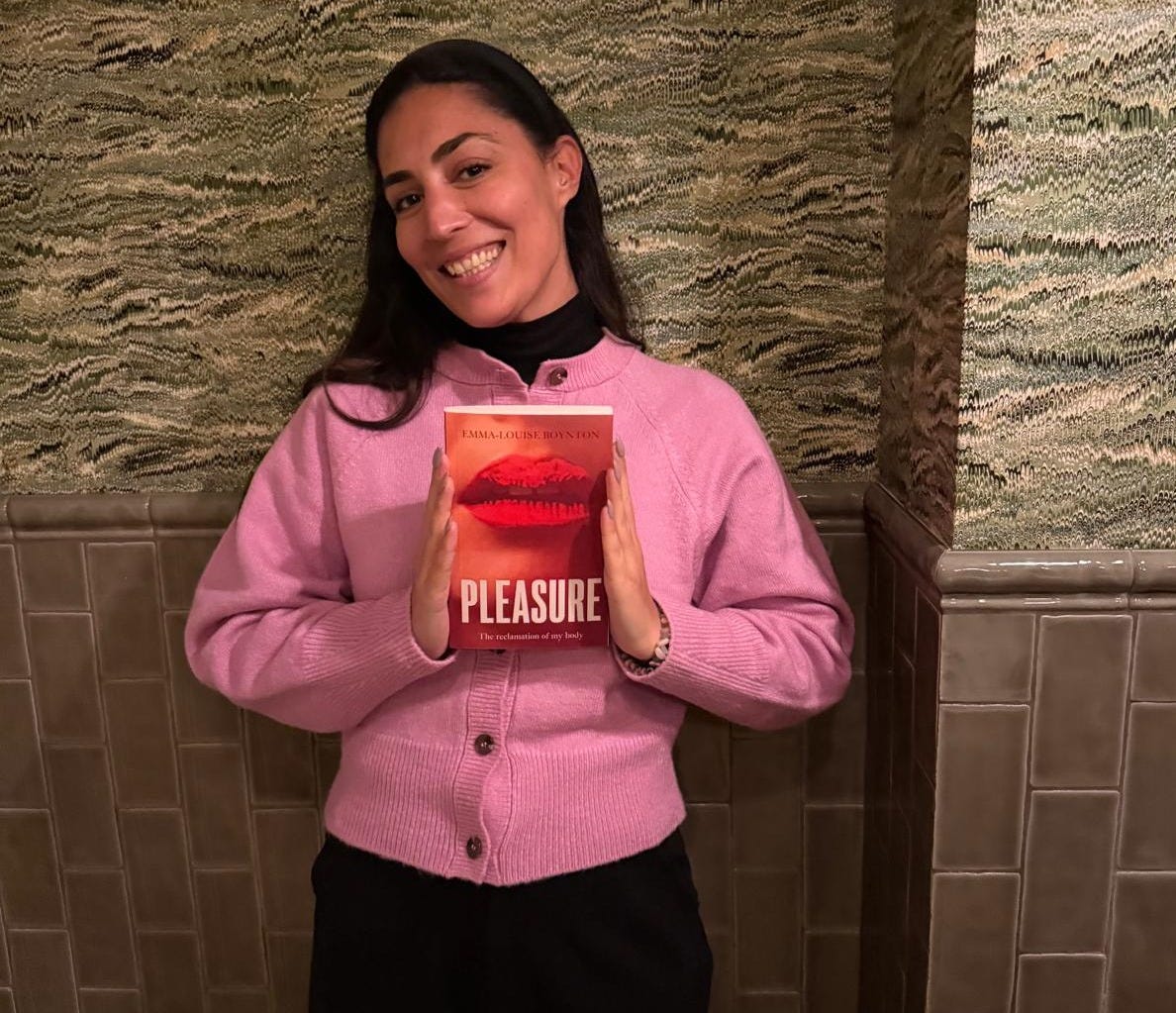
“We only know how to be desired. We don’t know how to desire. We only know how to be wanted. We don’t know how to want,” wrote my friend Emma-Louise Boynton in her debut book, Pleasure, which was released last month. Her voice joined the chorus of women I have been seeking out over recent years: women naming the fact that if you are taught to experience yourself primarily from the outside, as an image to be assessed, chosen, improved or consumed, it becomes much harder to know yourself from the inside. Harder still to recognise all the ways we orient ourselves around other people’s desires, even while calling them something else.
In my favourite chapter of the book, Emma writes about the version of sexual liberation many of us were handed: one that confuses detachment with freedom, and a studied lack of care with power. What was sold to us as autonomy is often, Emma suggests, only imitation. An attempt to do and be what a patriarchal world tells us is better and normal. To be unbothered. Unneedy. Always up for it. Never the one who cares more. Never the one who wants too visibly. If I sound jaded by this, it’s because I am. Because I attempted all this, too, and learned the hard way that there is nothing liberatory in exchanging one performance for another if both require the same abandonment of the self.
What Pleasure understands is that while sex is perhaps the arena in which these dynamics and this disconnect can most obviously be seen and felt, it’s only one example. That as women, we are taught not only to suppress desire; but to distrust the part of ourselves that desires at all. Taught that there is a right and a wrong way, and that our way is always wrong.
In The Gender of Sound, Anne Carson traces the long association of femininity with excess: too loud, too porous, too emotional, too unruly, too much. Masculinity, on the other hand, is cast as the stable and self-governing norm. Once you have absorbed that logic, it becomes difficult to trust your own appetite in any form. What follows is a kind of pre-emptive self-doubt, as though wanting too openly might confirm the very excess you have been taught to fear in yourself. And that’s when it comes to everything - sex, yes, but also food, love, money, attention, rest, beauty, ambition; for more than the version of a life you were told should be enough.
I don’t know that there is a truer, purer self buried underneath all this, waiting for us if only we excavate carefully enough. We are shaped by too much for that. The work, for me then, has been less about purity than about attempting to hear what is mine clearly enough. At the very least just to hear it. To have a chance to build a life rooted in that.
Coming across Audre Lorde and her writing on the erotic as power shifted things for me because she gave me language for desire as something more than mere indulgence, or sexuality, but instead as a form of knowledge; a life-force and a discernment; a way of feeling the difference between what animates me and what asks me to go numb. An inner signal that tells me when to act, when to stay, when to create, when to go.
Writing has always been one way of reaching that knowledge, a way of lowering the noise enough to hear myself. What was harder was the work of building trust with a self that had learned, over years, to override, betray, aestheticise, suppress, or outsource its own wanting. To stop treating it as if it were already suspect and excessive.
On the eve of my 37th birthday, I think I am beginning to hear myself with less fear of what I might find, or what it would ask of me. And, crucially, to begin to trust myself enough to let that shape the life I am making. Alhamdullilah.
-Alya xo
What has shaped your relationship to wanting - and what has helped you hear yourself more clearly? Leave a comment below or press ‘reply’ to write to me directly.
I’m Alya Mooro, a writer and author of The Greater Freedom: Life as a Middle Eastern Woman Outside the Stereotypes. My work explores voice, womanhood, shame, desire, and the long work of becoming. I write about the stories we inherit, the selves we outgrow, and what it takes to live from the centre of ourselves.
You can support this space - and go deeper with my work - by becoming a paid subscriber. Tapping the heart, sharing your thoughts, or forwarding this to someone who might need it helps. Thank you for being here. You can find me on Instagram too.